Research on Spatiotemporal Evolution Characteristics and Collaborative Control Strategies of Pollution Sources in Industrial Parks Based on Machine Learning
Keywords:
Industrial Park, Machine Learning, Spatial-Temporal Graph Convolutional Network, Multi-Agent Reinforcement Learning, Collaborative ControlAbstract
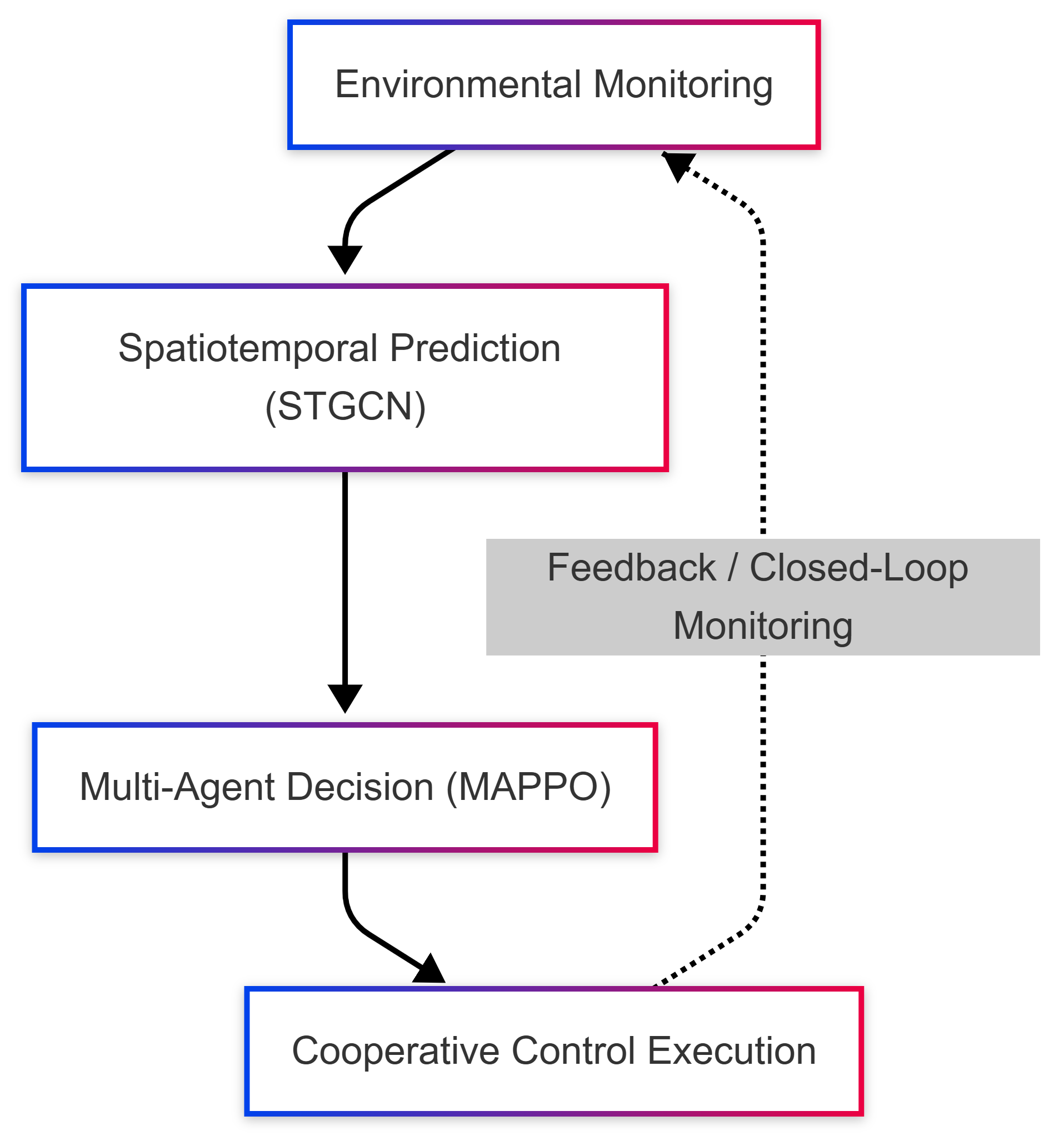
This study proposes a machine learning framework combining STGCN and MAPPO for regional collaborative pollution control in industrial parks, which reduces operational energy consumption by 13.6% and decreases core pollutant exceedance frequency by 89.5%.
References
Wang, J., et al. (2022). Spatial-temporal modeling of urban air pollution using graph neural networks. Atmospheric Environment, 274, 118991.
Zhao, M., et al. (2021). Graph convolutional networks for spatial-temporal forecasting in environmental monitoring. IEEE Access, 9, 45213-45225.
Li, H., Wang, J., & Zhang, Y. (2020). Deep reinforcement learning in industrial process control: A review. IEEE Transactions on Industrial Informatics, 16(11), 6988-7001.
Chen, X., & Liu, Y. (2023). Multi-agent reinforcement learning for environmental systems and smart grids. Journal of Environmental Management, 285, 112-125.
Zhang, Y., et al. (2023). Air quality prediction using machine learning: A comprehensive review. Environmental Pollution, 316, 120531.