Assignment-Informed Link-Flow Forecasting: A Case Study in Wuxi
Keywords:
Route choice, Origin destination demand, Flow Forecasting, DetectorAbstract
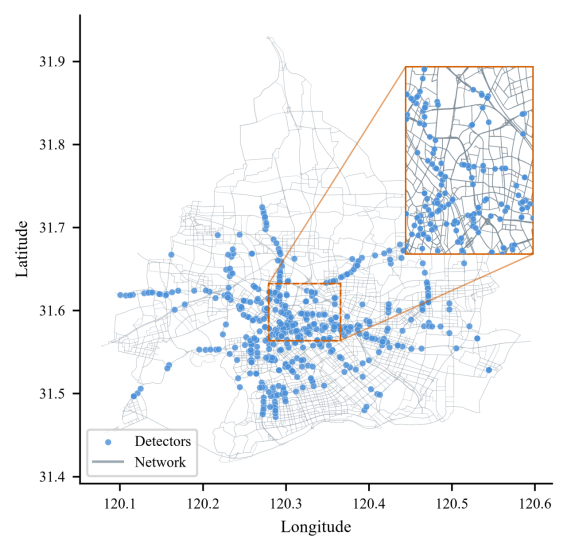
Road restrictions and changing travel demand can alter link flows before recent detector counts describe the new pattern. This study develops a selective assignment correction for traffic flow forecasting in Wuxi. A relative cost Logit model translates OD demand and road costs into changes in route use. Link specific calibration adjusts the response scale, and an assignment state rule directs the correction toward substantial departures from recurring conditions. The study combines observed detector counts, OD demand and the Wuxi road network. Comparisons cover supplied road cost changes, several forecasting backbones, prediction horizons and persistent flow drops. Assignment improves forecasts in strong path states and adds a useful correction to models that already use recent detector histories. The benefit increases with assigned state strength and remains visible across test dates. Calibrating service ratios also improves forecasts during persistent drops. These findings indicate how route information can supplement an established detector forecast. Broader observation periods, independent demand sources and documented disruptions would support assessment across a wider range of operating conditions.
References
[1]Yu, B., Yin, H., & Zhu, Z. (2018). Spatio-Temporal Graph Convolutional Networks: A Deep Learning Framework for Traffic Forecasting. In Proceedings of the Twenty-Seventh International Joint Conference on Artificial Intelligence (pp. 3634–3640). International Joint Conferences on Artificial Intelligence Organization. https://doi.org/10.24963/ijcai.2018/505
[2]Wu, Z., Pan, S., Long, G., Jiang, J., & Zhang, C. (2019). Graph WaveNet for Deep Spatial-Temporal Graph Modeling. In Proceedings of the Twenty-Eighth International Joint Conference on Artificial Intelligence (pp. 1907–1913). International Joint Conferences on Artificial Intelligence Organization. https://doi.org/10.24963/ijcai.2019/264
[3]Wang, W., Wang, J., Zhao, D., & Jin, K. (2022). A Revised Logit Model for Stochastic Traffic Assignment With a Relatively Stable Dispersion Parameter. IEEE Intelligent Transportation Systems Magazine, 14(2), 92–104. https://doi.org/10.1109/MITS.2021.3131887
[4]Peeta, S., & Ziliaskopoulos, A. K. (2001). Foundations of Dynamic Traffic Assignment: The Past, the Present and the Future. Networks and Spatial Economics, 1(3), 233–265. https://doi.org/10.1023/A:1012827724856
[5]Jiang, W., & Luo, J. (2022). Graph neural network for traffic forecasting: A survey. Expert Systems with Applications, 207, 117921. https://doi.org/10.1016/j.eswa.2022.117921
[6]Zhao, L., Guo, B., Dai, C., Shen, Y., Chen, F., Zhao, M., & Hu, Y. (2024). Multi-step trend aware graph neural network for traffic flow forecasting. Big Data Research, 38, 100482. https://doi.org/10.1016/j.bdr.2024.100482
[7]Wang, Z., Wang, Y., Jia, F., Zhang, F., Klimenko, N., Wang, L., He, Z., Huang, Z., & Liu, Y. (2024). Spatiotemporal Fusion Transformer for large-scale traffic forecasting. Information Fusion, 107, 102293. https://doi.org/10.1016/j.inffus.2024.102293
[8]Hu, J., Zheng, T., Peng, L., Teng, F., Du, S., & Li, T. (2025). LightST: A Simplifying Spatio-Temporal Graph Neural Network for Traffic Flow Forecasting. IEEE Transactions on Big Data, 11(5), 2517–2528. https://doi.org/10.1109/tbdata.2025.3544131
[9]Jia, X., Dong, X., Chen, M., & Yu, X. (2021). Missing data imputation for traffic congestion data based on joint matrix factorization. Knowledge-Based Systems, 225, 107114. https://doi.org/10.1016/j.knosys.2021.107114
[10]Kong, X., Zhou, W., Shen, G., Zhang, W., Liu, N., & Yang, Y. (2023). Dynamic graph convolutional recurrent imputation network for spatiotemporal traffic missing data. Knowledge-Based Systems, 261, 110188. https://doi.org/10.1016/j.knosys.2022.110188
[11]Hou, M., Tang, T., Xia, F., Sultan, I., Kaur, R., & Kong, X. (2024). MissII: Missing Information Imputation for Traffic Data. IEEE Transactions on Emerging Topics in Computing, 12(3), 752–765. https://doi.org/10.1109/tetc.2023.3280481
[12]Li, H., Han, S., Yang, M., Liu, J., Zhou, J., Zhang, T., & Philip Chen, C. L. (2025). Dynamic Spatial-Temporal Imputation Network With Missing Features for Traffic Data Imputation. IEEE Internet of Things Journal, 12(14), 29005–29017. https://doi.org/10.1109/jiot.2025.3567697
[13]Zhang, Y., Kong, X., Zhou, W., Liu, J., Fu, Y., & Shen, G. (2024). A Comprehensive Survey on Traffic Missing Data Imputation. IEEE Transactions on Intelligent Transportation Systems, 25(12), 19252–19275. https://doi.org/10.1109/tits.2024.3478816
[14]Huang, Y., & Yang, J. J. (2024). Symmetric contrastive learning for robust fault detection in time-series traffic sensor data. International Journal of Data Science and Analytics, 20(2), 1199–1213. https://doi.org/10.1007/s41060-024-00521-0
[15]Gagliardi, G., Casavola, A., & D’Angelo, V. (2023). Reliable Traffic Sensor Networks Via Fault-Tolerant Sensor Reconciliation Schemes. IFAC-PapersOnLine, 56(2), 10558–10563. https://doi.org/10.1016/j.ifacol.2023.10.312
[16]Mishra, M., Mishra, S., & Har, D. (2024). Integrating Multisourced Sensor Data for Enhanced Traffic State Estimation. IEEE Sensors Journal, 24(12), 19614–19625. https://doi.org/10.1109/jsen.2024.3397534
[17]Fulari, S., Vanajakshi, L., & Subramanian, S. C. (2017). Artificial Neural Network–Based Traffic State Estimation Using Erroneous Automated Sensor Data. Journal of Transportation Engineering, Part A: Systems, 143(8), 05017003. https://doi.org/10.1061/jtepbs.0000058
[18]Aslam, J., Lim, S., Pan, X., & Rus, D. (2012). City-scale traffic estimation from a roving sensor network. In Proceedings of the 10th ACM Conference on Embedded Network Sensor Systems (pp. 141–154). ACM. https://doi.org/10.1145/2426656.2426671